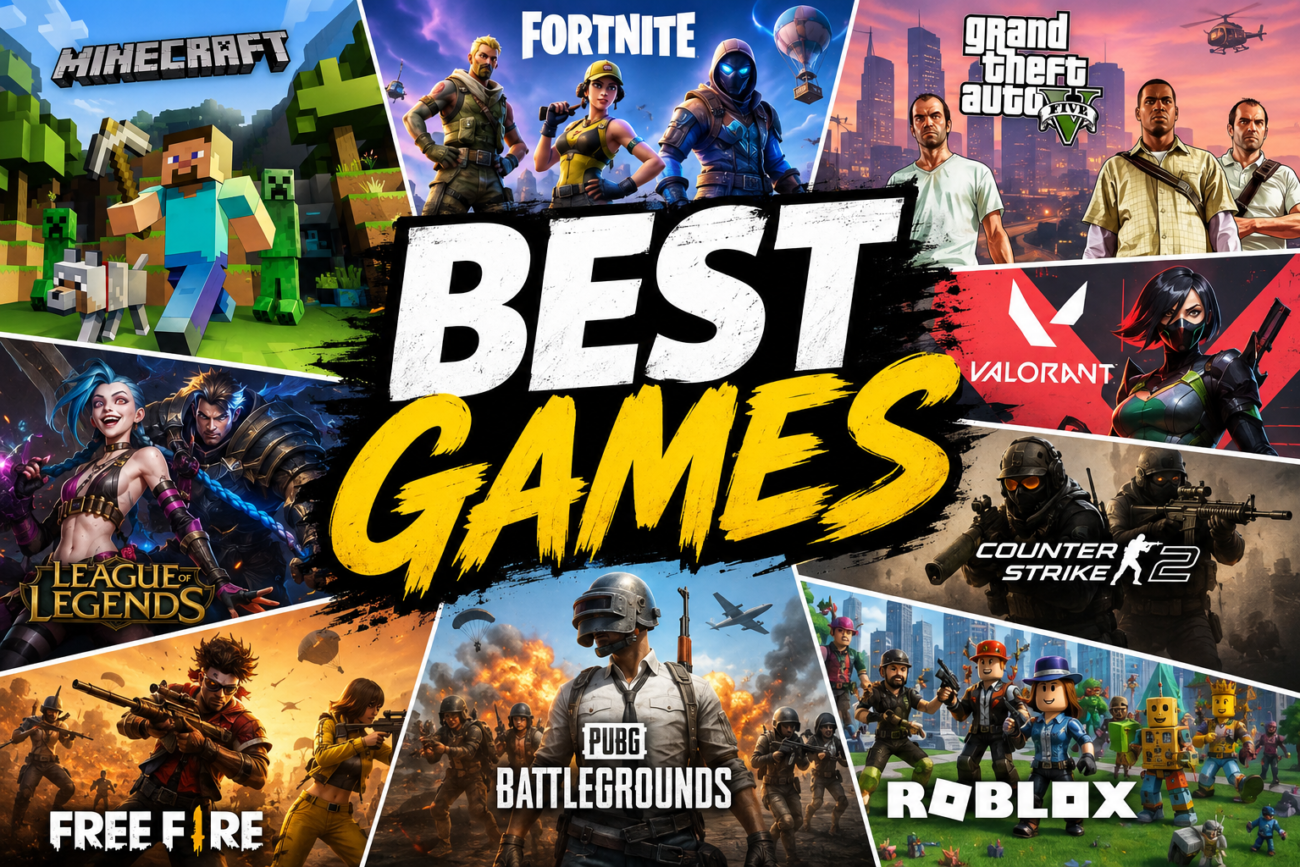
Video games have become one of the biggest forms of entertainment on the planet. What was once considered a simple hobby has evolved into a massive global industry where millions of people play, compete, watch livestreams, create videos, participate in online communities, and follow their favorite games every day.
Today, popularity cannot be measured by a single number. Some games have enormous monthly audiences, others have hundreds of millions of registered accounts, while others dominate competitive gaming and livestreaming platforms. Because of this, there is no universal ranking that can perfectly determine which game is number one.
However, several titles consistently stand among the most influential and widely played games worldwide, including Roblox, Minecraft, Fortnite, League of Legends, Free Fire, Counter-Strike 2, PUBG, Grand Theft Auto V, Valorant, Candy Crush Saga, and Mobile Legends: Bang Bang.
Roblox: More Than Just a Game
Roblox occupies a unique position in the gaming industry because it is not simply a traditional video game. It is a massive online platform where users can play experiences created by other people while also having the ability to create their own games and virtual worlds.
This variety is one of the main reasons behind Roblox’s enormous popularity. One player might enter Roblox looking for an adventure game, while another may prefer racing, role-playing, survival, simulation, horror, or competitive experiences.
The platform’s community is also one of its biggest strengths. Players are not only consumers of content; they can become creators themselves. New experiences are constantly appearing, meaning that the platform can continue attracting users without relying entirely on a single game mode.
Roblox has become especially important among younger audiences and has developed a massive ecosystem around creators, virtual items, communities, and social interaction.
Minecraft: A Game That Never Gets Old
Minecraft is one of the most recognizable video games in history. Its concept is simple: explore a world made of blocks, collect resources, build structures, and survive. Yet that simplicity has allowed the game to remain relevant for many years.
Players can approach Minecraft in completely different ways. Some spend their time constructing enormous cities and buildings, while others explore caves, fight enemies, discover rare resources, or play on competitive multiplayer servers.
Another important part of Minecraft’s success is its creative freedom. Players can build almost anything they can imagine, which has generated an enormous amount of content across YouTube, livestreaming platforms, social media, and gaming communities.
Minecraft is also a game that can be enjoyed casually or played for thousands of hours. That flexibility has helped it maintain one of the strongest communities in gaming.
Fortnite: A Constantly Evolving Experience
Fortnite changed the Battle Royale genre and helped redefine what an online game could become.
The basic concept is easy to understand: players enter a large map, collect equipment, survive against opponents, and attempt to become the last player or team standing. However, Fortnite’s long-term success has come from much more than its original Battle Royale formula.
The game constantly introduces new seasons, characters, weapons, maps, collaborations, events, and limited-time experiences. Fortnite has also collaborated with major entertainment franchises, celebrities, athletes, and brands.
This has transformed the game into a digital entertainment platform where gaming, music, pop culture, and social interaction can exist together.
Fortnite also demonstrates the importance of keeping a game fresh. Instead of releasing a completely new product every year, its developers have created an environment that can continually change.
League of Legends: A Global Competitive Giant
League of Legends is one of the most important competitive games ever created.
The game features teams of players competing against each other while controlling unique champions with different abilities. Winning requires communication, strategy, teamwork, mechanical skill, and an understanding of the game’s constantly evolving systems.
League of Legends is particularly powerful because its audience extends beyond people who actively play the game.
Millions of viewers watch professional matches, tournaments, streamers, and content creators. Major esports events can attract enormous international audiences.
The competitive scene has helped League of Legends remain relevant for more than a decade and has created professional players, teams, coaches, analysts, broadcasters, and entire esports organizations around the game.
Free Fire: A Mobile Gaming Powerhouse
Free Fire became one of the biggest Battle Royale games on mobile devices.
One of its strongest advantages is accessibility. The game was designed to be playable on a wide range of smartphones, making it possible for people without expensive gaming devices to participate in online competitive gaming.
The relatively short matches also fit naturally into mobile gaming habits. Players can complete a match without needing to dedicate an entire hour to a single session.
Free Fire has developed particularly strong communities across Latin America, Southeast Asia, India, and other regions where smartphones are one of the primary ways people access online entertainment.
Its constant events, characters, cosmetics, collaborations, and competitive scene have helped maintain a large and active global audience.
Counter-Strike 2: Competitive Gaming at Its Core
Counter-Strike 2 represents a different approach to popularity.
Instead of focusing primarily on open worlds or constant entertainment events, Counter-Strike is built around competitive tactical gameplay.
Players compete in rounds where accuracy, communication, positioning, economy management, and decision-making can determine the outcome of a match.
Its competitive nature has created an extremely dedicated community. Players can spend years improving their skills, learning maps, studying strategies, and attempting to reach higher ranks.
Counter-Strike also has one of the most established esports ecosystems in gaming, with professional tournaments watched by audiences around the world.
PUBG and the Rise of Battle Royale
PUBG: Battlegrounds played an important role in popularizing the modern Battle Royale formula.
The idea of dropping into a large map, searching for equipment, surviving against other players, and becoming the last survivor created an entirely different type of competitive experience.
PUBG’s success also expanded through mobile gaming. PUBG Mobile introduced the Battle Royale experience to an enormous smartphone audience and became one of the most recognizable competitive mobile games.
The game’s popularity demonstrated how powerful the combination of survival, competition, strategy, and unpredictability can be.
Every match can develop differently, which gives players a reason to continue playing even after hundreds of games.
Grand Theft Auto V and GTA Online
Grand Theft Auto V is another extraordinary example of long-term popularity.
Released years ago, the game continues to attract players through its online component, GTA Online.
The open-world environment allows players to participate in missions, races, businesses, activities, competitive modes, and countless other experiences.
GTA V has also become one of the biggest games in the streaming world. Content creators have transformed GTA Online into a source of entertainment that goes far beyond traditional gameplay.
Role-playing servers have been particularly important. Players can create characters, interact with other players, and participate in improvised stories inside the game’s virtual world.
This type of community-driven content has helped extend the life of GTA V far beyond what many people expected from a traditional single-player game.
Valorant: Precision, Strategy, and Competition
Valorant combines tactical shooting with unique character abilities.
Each player chooses an agent with specific skills, creating an additional strategic layer beyond traditional shooting mechanics.
Matches require communication, precision, map knowledge, teamwork, and fast decision-making.
Since its launch, Valorant has become one of the major competitive PC games and has established a strong international esports scene.
Its combination of accessible gameplay and high skill potential makes it attractive to both casual players and highly competitive gamers.
Candy Crush Saga: The Power of Casual Gaming
Not every successful game needs to be competitive or technically demanding.
Candy Crush Saga demonstrates how powerful casual mobile gaming can be.
Its simple match-based gameplay allows players to enjoy short sessions almost anywhere. A person can play for a few minutes while waiting for transportation, taking a break, or simply relaxing at home.
The game does not require players to learn complicated controls or understand an extensive competitive system.
Its simplicity is precisely what made it accessible to an enormous audience.
Candy Crush also demonstrates an important fact about the gaming industry: a game does not need to target hardcore gamers to become a global phenomenon.
Mobile Legends: Bang Bang
Mobile Legends: Bang Bang has become one of the most important mobile MOBA games worldwide.
Its format allows players to participate in competitive team battles directly from their smartphones.
The matches are designed to be relatively accessible compared with many traditional PC MOBAs, which makes the game particularly attractive to mobile audiences.
Mobile Legends has developed a strong following in several Asian markets and has also created its own professional esports ecosystem.
Its success demonstrates how mobile devices have transformed competitive gaming by making online multiplayer experiences available to a much larger population.
Why Are These Games So Popular?
Although these games are completely different from one another, many of them share several important characteristics.
Accessibility
A game becomes much easier to grow when people can access it without expensive hardware.
Mobile gaming has played an enormous role in expanding the global gaming audience because smartphones are available to billions of people.
Free-to-Play Models
Many of the biggest online games use a free-to-play model.
Instead of requiring players to purchase the game before trying it, developers allow users to enter for free and generate revenue through optional purchases, cosmetics, battle passes, or other systems.
This dramatically reduces the barrier for new players.
Constant Updates
Modern players expect games to evolve.
New characters, maps, weapons, events, seasons, challenges, cosmetics, and gameplay changes give players new reasons to return.
Games such as Fortnite, Free Fire, Roblox, and many others have built their communities around this continuous-update model.
Social Interaction
Gaming has become increasingly social.
People no longer play only against computer-controlled opponents. They play with friends, communicate through voice chat, meet new players, join communities, and share their experiences online.
For many people, the social experience is just as important as the gameplay itself.
Content Creators
YouTube, TikTok, Twitch, Facebook, and other platforms have completely changed how people discover games.
A player might see a funny Minecraft video, a Free Fire highlight, a Fortnite event, a GTA roleplay stream, or a League of Legends tournament and become interested in the game.
This creates a powerful cycle between gaming and social media.
Competitive Gameplay
Competitive games have another advantage: they give players a reason to improve.
Ranking systems, tournaments, leaderboards, professional competitions, and personal achievements can keep players engaged for years.
Video Games and Streaming
The popularity of a game cannot be measured only by the number of people who play it.
Another important measurement is the number of people who watch it.
Games such as League of Legends, GTA V, Counter-Strike, Minecraft, Valorant, Fortnite, and others have developed enormous audiences on streaming and video platforms.
A player may spend hours watching someone else play a game before ever downloading it.
Professional esports has also transformed gaming into a spectator activity. Major tournaments can attract viewers who may not even play the game themselves.
This has created a new ecosystem involving players, streamers, professional teams, tournament organizers, commentators, content creators, and fans.
What Is the Most Popular Game in the World?
The answer depends entirely on how popularity is measured.
If the measurement is monthly or daily activity, platforms such as Roblox can appear extremely high on the list.
If the measurement is lifetime sales, Minecraft is one of the industry’s biggest success stories.
If the measurement is registered accounts, Fortnite has reached an extraordinary global scale.
If the measurement focuses on esports and competitive viewing, games such as League of Legends and Counter-Strike become particularly important.
Mobile titles such as Free Fire, PUBG Mobile, and Mobile Legends also demonstrate that the global gaming audience is no longer concentrated on PCs and consoles.
For that reason, there is no single statistic capable of describing the entire gaming industry.
The Future of Global Gaming
The future of gaming will probably become even more connected to social media, streaming, mobile devices, artificial intelligence, user-generated content, and online communities.
Players increasingly expect games to become living digital worlds rather than products that remain unchanged after launch.
Developers are therefore focusing on long-term communities, frequent updates, seasonal content, events, cross-platform experiences, and tools that allow players to create their own content.
The competition between games will also become increasingly global. A player using a smartphone in Latin America can compete with someone on another continent, while a creator can reach millions of viewers without needing traditional television or media companies.
Final Thoughts
The biggest video games in the world are successful for different reasons.
Minecraft succeeded through creativity and freedom. Roblox built an enormous ecosystem around user-generated experiences. Fortnite transformed itself into an evolving entertainment platform. League of Legends became a competitive phenomenon. Free Fire and other mobile games brought large-scale online gaming to smartphones. Counter-Strike built its identity around precision and competition, while GTA V demonstrated the incredible longevity of a well-developed online world.
What connects these games is not their graphics, genre, or platform.
It is their ability to create communities.
The most successful games are no longer simply games that people purchase and finish. They are digital worlds that people return to, talk about, watch, share, compete in, and experience with others.
That is why the world’s biggest games continue to attract millions of players long after their original release. Their greatest achievement is not simply the number of people who have downloaded them, but their ability to become part of everyday digital culture.
